
The AI Workflows Modern Teams Use to Scale Faster
An AI marketing agency operates differently from traditional agencies. Instead of relying only on manual execution, it builds structured systems powered by AI workflows to scale content, ads, and SEO efficiently.
Three years ago, a growing agency struggled with scale. Clients demanded blogs, landing pages, ad creatives, email funnels, and SEO content all at once. Deadlines were tight. Teams were stretched thin. Hiring more writers meant higher costs and slower onboarding.
That’s when the agency evolved into a performance-driven model supported by AI workflows.
Not to replace people but to remove bottlenecks.
Why Modern Agencies Are Adopting AI Workflows

Marketing today moves fast.
Content volume is increasing.
SEO competition is rising.
Campaign cycles are shorter than ever.
A structured AI system allows agencies to handle research, drafting, optimization, and repurposing without overwhelming their teams.
Instead of adding headcount, they improve process efficiency.
7 AI Workflows That Help Agencies Scale
1. Strategy Mapping
Every campaign begins with:
- Clear objectives
- Funnel alignment
- Audience segmentation
- Keyword mapping
AI supports the process it doesn’t define it.
2. Search & Keyword Intelligence
Using tools like Ahrefs, agencies identify:
- High-intent keywords
- Ranking opportunities
- Content gaps
This ensures every article has ranking potential before drafting begins.
3. Draft Acceleration
With structured prompts, AI tools generate:
- Blog outlines
- First drafts
- FAQ sections
- Multiple ad variations
What once took five hours now takes one.
Creative teams then refine messaging and tone.
4. SEO Optimization
Content is enhanced using optimization tools to improve:
- NLP coverage
- Heading structure
- Semantic relevance
- Internal linking
This ensures performance-ready publishing.
5. Content Repurposing
One long-form article becomes:
- LinkedIn posts
- Instagram captions
- Email newsletters
- Ad scripts
- Short-form video content
This multiplies output without multiplying effort.
6. Performance Testing
Because production cycles are faster, agencies test:
- Multiple hooks
- Different headlines
- Alternate CTAs
Data improves. Decisions become sharper.
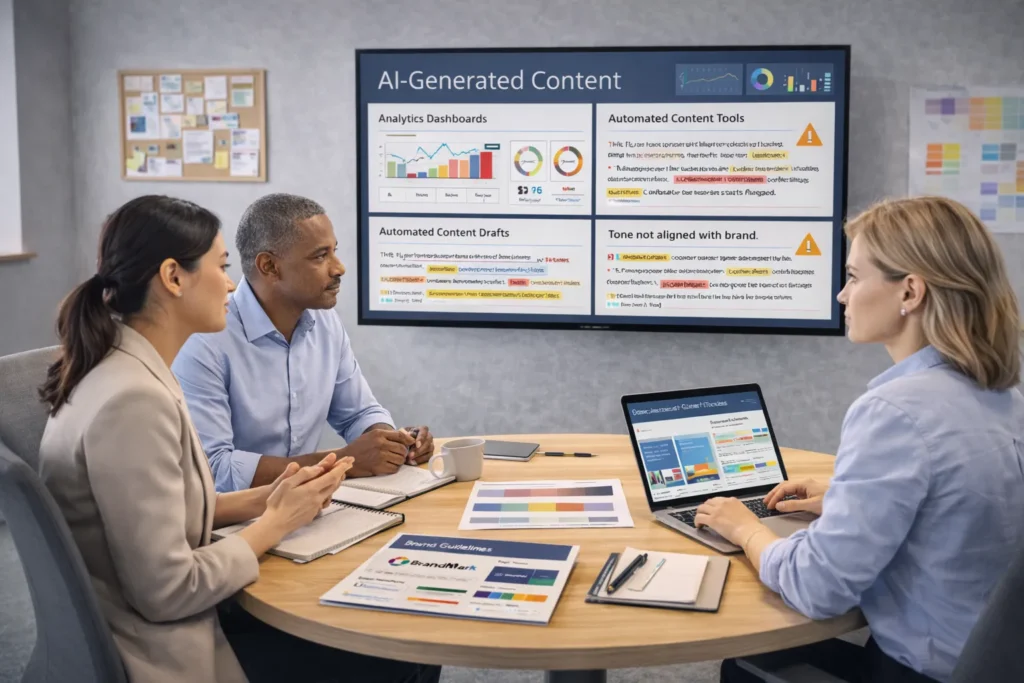
7. Human-Led Refinement
This is critical.
Automation handles structure and speed.
Humans handle storytelling, persuasion, and brand voice.
The most successful teams combine both.
What Changes After 90 Days?
Agencies implementing structured AI workflows typically experience:
- Faster turnaround times
- Better SEO alignment
- Improved consistency
- Reduced internal burnout
A five-member team can manage workloads that previously required ten.
That’s not just efficiency.
That’s operational leverage.
The Competitive Advantage
Search engines prioritize structured, intent-driven content. AI-supported systems help maintain consistency across campaigns and clients.
But the real advantage isn’t just speed.
It’s clarity.
Instead of chaos, there is process.
Instead of reactive execution, there is planned growth.
Final Perspective
This isn’t about chasing trends.
It’s about building structure that outlasts them.
An AI marketing agency doesn’t win because it uses tools it wins because it builds repeatable AI workflows that remove friction from execution. When systems are clear, creativity has room to expand instead of constantly reacting to pressure.
Speed becomes sustainable.
Quality becomes consistent.
Strategy becomes sharper.
That’s the real shift.
AI workflows handle the operational weight research, structure, variations, optimization while humans focus on positioning, storytelling, and performance thinking. The result isn’t robotic content. It’s refined output powered by intelligent systems.
Agencies that understand this don’t scale through chaos. They scale through clarity. They don’t rely on last-minute pushes. They rely on processes that support performance.
And over time, that operational discipline compounds.
Because in a market where everyone is producing content, the agencies that combine structured AI workflows with strategic human direction aren’t just keeping up.
They’re building momentum that lasts.
And that momentum creates leverage.
Leverage in time.
Leverage in decision-making.
Leverage in client growth.
An AI marketing agency built on strong AI workflows can onboard faster, execute smarter, and adapt quicker to market shifts. Instead of constantly expanding headcount, it expands capability. Instead of reacting to algorithm changes, it anticipates them.
That strategic maturity is what turns short-term wins into long-term authority.