Three years ago, scaling a creative agency meant one thing: hire more editors.
More clients meant more retouching.
More product shoots meant more background corrections.
More campaigns meant more resizing, color grading, and export variations.
The workload multiplied faster than the team could grow.
Today, that scaling model looks different.
Modern agencies are building structured systems around AI photo editing for agencies — not to cut corners, but to increase efficiency without lowering standards.
The Real AI Design Workflow Inside Agencies
When agencies integrate AI properly, they don’t “just use AI tools.” They redesign their workflow.
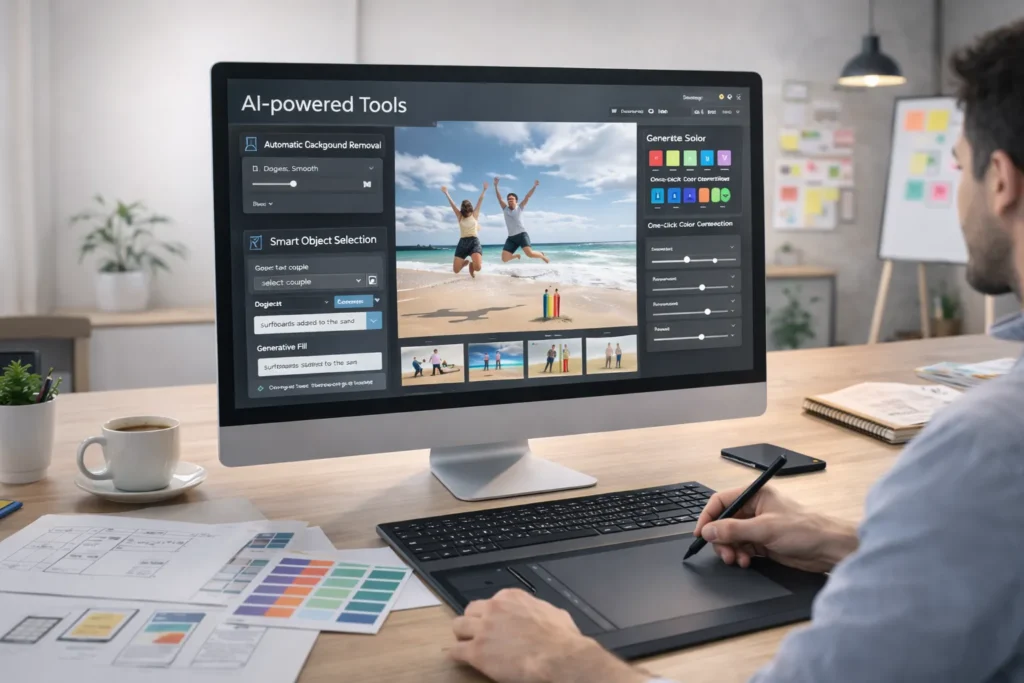
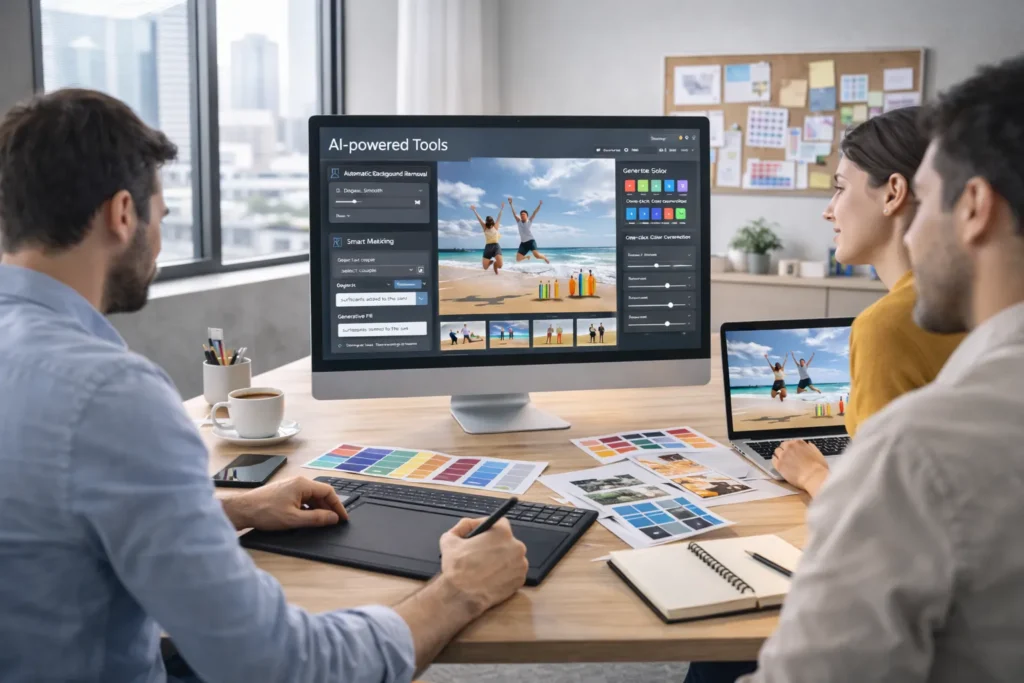
Inside Adobe Photoshop, AI-powered features like generative fill, auto subject detection, and neural filters reduce repetitive tasks dramatically.
Here’s what a real agency AI design workflow looks like:
1️⃣ Intake & Asset Sorting
AI helps categorize images by type — product, lifestyle, campaign, catalog.
2️⃣ Smart Selection & Masking
AI auto-detects subjects with high precision, reducing manual masking time.
3️⃣ AI Retouching
Skin smoothing, lighting correction, and minor imperfections are handled through automated retouching layers.
4️⃣ Background Optimization
Generative fill adjusts or replaces backgrounds instantly while maintaining realistic lighting and shadows.
5️⃣ Multi-Platform Output
Images are resized and adapted for website, Instagram, ads, and email campaigns efficiently.
This structured AI retouching system allows agencies to reduce editing time by 40–60% in high-volume projects.
But the deeper impact is operational.
Agencies can now:
- Handle more clients
- Deliver faster turnaround
- Maintain visual consistency
- Reduce revision cycles
AI photo editing becomes a scaling engine.
What Changes Inside the Team
Interestingly, AI doesn’t reduce the need for designers.
It elevates their role.
Junior designers spend less time on technical cleanup.
Senior creatives focus more on art direction and brand refinement.
Project managers gain predictable delivery timelines.
AI removes bottlenecks — not creativity.
The agency becomes more agile.
But Is AI Always Better Than Traditional Editing?
This is where the bigger conversation begins.
While AI photo editing for agencies increases speed and efficiency, traditional Photoshop editing still offers unmatched manual precision in complex scenarios.
If you want a deeper comparison, read:
“AI Image Editing vs Traditional Photoshop: Which Is Better?”
That article breaks down:
- AI image editing vs Photoshop workflows
- When AI editing tools outperform manual editing
- When traditional Photoshop editing still wins
- Accuracy vs creative control
- Automation vs craftsmanship
Together, these two perspectives create clarity:
- This blog explains how agencies implement AI at scale.
- The comparison blog explains where AI fits within traditional editing methods.
Scale + strategy.
The Strategic Advantage for Agencies
Agencies that master AI photo editing gain:
- Higher client capacity
- Faster campaign execution
- Lower production fatigue
- Improved profit margins
- More room for creative experimentation
The real advantage is not just speed.
It’s confidence in scale.
Instead of fearing large projects, agencies can accept them.
Instead of worrying about delivery timelines, they optimize them.
AI retouching and AI design workflow systems don’t replace traditional Photoshop skills — they enhance them.
The agencies winning today are not choosing between AI and manual editing.
They are integrating both intelligently.